Why Study CIMA?

We're giving you more reasons to choose CIMA among all others!

CIMA VS ACCA

Cannot decide if you'll take CIMA or ACCA?

Frequently Asked Questions

You might have a lot of questions - we can help you here.

How to nail CIMA exam?

We have few tips you can follow to pass the exam.

2015 New CIMA Syllabus

Check out what is new with CIMA.

Saturday, 1 October 2011

Information Systems

A – The Role of Information System
  • The role of information systems in organizations
  • Data and information
  • Types of information systems
  • Emerging trends in information systems
  • IT enabled transformation
  • IT and new forms of organization
  • Privacy and security

B – Systems Implementation and Business Strategy
  • System Implementation
  • Information technology and change management
  • Introducing the change
  • System evaluation
  • System maintenance
  • System outsourcing
  • Aligning systems with business strategy
A – The Role of Information System


1) The role of information systems in organizations


a. Recording transactions – documentation of transactions can be used as evidence in case of dispute. There may be a legal requirement to record transactions (i.e. accounting and audit purposes)

b. Decision Making – to make informed decisions

c. Planning – requires a knowledge of, available resources, possible time-scales for implementation and the likely outcome under alternative scenarios

d. Performance Measurement – comparisons against budget or plan which involves the collection of information (i.e. costs, revenues, volumes, time-scale and profitability)

e. Control - information is required to assess whether it is proceeding as expected

2) Data and information


Data – consists of raw, unprocessed facts and figures
Information – data that has been processed in a way that makes it meaningful for planning or decision making

Stages:
- Data collection
- Data evaluation
- Data analysis
- Interpretation
- Reporting

a. Internal data and information – held within the organization’s own files (APAT)
A – Accounting records
P – Personal records
A – A production data
T - Timesheets

b. External data and information (PEST)


Political – national or local politics may affect how an organization operates. Changes in legislation may put new responsibilities or liabilities on an organization
Economic – affect an organization’s finances such as availability of loans or sales levels
Social – Society’s view may put pressure on how the organization is run, like pressure to reduce environmental pollution
Technological – allow the development of new products and services which were not previously possible

Environmental Scanning – process of gathering external information from a wide range of sources

c. The qualities of information (ACCURATE)

A – Accurate, figures in a report should add up, the degree of rounding should be appropriate
C – Complete, information should include everything relevant to the decision being considered. It should be consistent
C – Cost Beneficial, it should not cost more to obtain the information that the benefit derived from its use
U – User targeted, the needs of the user are paramount
R – Relevant, all significant information that is relevant o the decision being considered should be included
A – Authoritative, the source of the information should be a reliable one
T – Timely, the information should be available when it is needed and in time for required action to be effective
E – Easy to use, information should be understandable. It should be clearly presented, not excessively long, and sent using the right medium and communication channel

3) Types of information systems


a. Information systems at different organizational levels
Information system – general concept that refers to the people, data and activities, both computer-based and manual, that effectively gather, process, store and disseminate information

b. Transactions Processing System (TPS) – performs and records routine transactions. This is used for the routine task in which data items or transactions must be process so that operations can continue. This is sometimes referred as Data Processing Systems (DPS)

c. Management Information Systems (MIS) – convert data from mainly internal sources into information. This information enables managers to make timely and effective decisions for planning, directing and controlling the activities for which they are responsible

Characteristics of MIS (RILES)
R – Relatively inflexible
I – Internal focus
L – Little analytical capability
E – Existing operations
S – Structured Decisions

d. Executive Information systems (EIS) – pools data from internal and external sources and makes information available to senior managers in an easy-to-use form, which will help to make strategic, unstructured decisions.

e. Decision Support Systems (DSS) – combine data and analytical models or data analysis tools to support semi-structured and unstructured decision making

DSS have more analytical power than other systems, enabling them to analyze and condense large volumes of data into a form that aids managers’ decision making

f. Knowledge Work Systems (KWS) – information systems that facilitate the creation and integration of new knowledge into an organization
Knowledge Workers – people whose jobs primarily involve creating new information and knowledge.
KWS help knowledge workers create new knowledge and expertise. Examples include:

  • Computer Aided Design
  • Computer Aided Manufacturing
  • Specialized financial software that analyses trading situations

g. Office Automation Systems (OAS) – computer systems designed to increase the productivity of data and information workers

h. Expert systems – form of DSS that allow users to benefit from expert knowledge and information.

i. Intranets and Extranets
Intranet – mini version of Internet. Organization members use networked computers to access information held on server.
Extranet – intranet that is accessible to authorized outsiders using a valid username and password.

j. Databases – collection of data organized to service many applications.
Database Management System (DBMS) – software that centralizes data and manages access to the database. It enables numerous applications to utilize the same files.

Characteristics of database system (SFC)
S – Shared. Different users are able to access the same data for their own processing applications.
F – Flexibility. The database system should provide for the needs of different users
C – Controls to preserve the integrity of the database

Advantages of database system (DWARFS)
D – Duplication. Avoidance of unnecessary duplication of data brings time and efficiency savings and reduced storage costs
W – Whole. Data is looked upon as serving the organization as a whole, not just for individual departments
A – Analyze data. The installation of a database system encourages management to analyze data, relationships between data items, and how data is used in different applications
R – Responsibility. Programmer is not responsible for the file organization
F – Flexibility. Data on file is independent of the user programs that access the data.
S – So Consistent. Because data is only held once, the possibility of departments holding conflicting on the same subject is reduced

Disadvantages of database system (uomfh)
U – Unauthorized access. There are problems of data security and data privacy. There is potential for unauthorized access to data.
O – One set of data. It is essential that the data should be accurate and free from corruption
M – Maintenance. There may be disputes over who ‘owns’ the data so has the right to decide how it is maintained
F – System Failure. Since data is held once, but its use is widespread, the impact of system failure would be greater
H – High initial development Cost. If an organization develops its own database system from scratch, initial development cost is high.

4) Emerging trends in information systems
a. Enterprise-wide systems – designed to coordinate all business functions, resources and information.

  • Each business areas is provided with a system that fulfills its needs, however each module shares a common database
  • Individual locations have their own specific data processing capability via a direct link to the central database (DDP)

b. Knowledge management systems – record and store the knowledge held within an organization.

  • Information held on a KMS is easily accessed and shared by employees
  • Primarily of benefit to knowledge based organizations, such as those involved in R&D or providing services such as legal advice

Benefits: (SPAR)
S – Easily shared
P – Valuable data is preserved
A – Duplication is avoided
R – Reduce the time they need to spend training


c. Customer relationship management systems – are software applications which specialize in providing information concerning an organization’s products, service and customers

  • Based on database which stores data about customers such as their order history and personal information

d. Web 2.0 and e-commerce
Web 2.0 Applications – second generation internet based services like blogs, rss feeds, wikis and youtube. Social media like Facebook and Twitter are part of this

e-Commerce – selling goods or services over the internet

5) IT enabled transformation – information technology maybe the driving force or trigger of organizational change. Even when IT is not a significant factor in the actual change, it can play an important part in the change management process. (TUM CASE)
T – Type of products or services that are made or sold
U – Source of unity and structure
M – Way the products are made
C – Enable change
A – Aid communication and co-ordination
S – Way in which services are provided
E – Way in which employees are mobilized

6) IT and new forms of organization
a. Virtual organizations

  •  Virtual teams – groups of people who aren’t based in the same office or organization but share information and task, make joint decisions and fulfill the collaborative function of a team.
  •  Virtual Company – collection of separate companies, each with a specific expertise, who work together, sharing their expertise to compete for bigger contracts/projects than would be possible if they worked alone
  • Virtual Supply Chain – supply chain that is enabled through e-business links, for example the web and extranets

b. Advantages of virtual operations (FIL)
F – Flexibility and speed of operation

I – Injection of market forces into all the linkages in the value chain

L – Low investment in assets and hence less risk involved

c. Disadvantages of virtual operations (CQRV)
C – Organizations must complement each other and form close relationships if the venture is to succeed
Q – Quality may be a problem owing to a loss of control
R – Resources may also be available to rival operations
V – Customers may recognize the virtual characteristics and this might negatively affect customer perceptions of the service or product

7) Privacy and security
a. Risk

  • Hackers and Eavesdroppers – attempt to gain unauthorized access to computer systems. They may attempt to damage a system or steal information.
  • Viruses – small piece of software which performs unauthorized actions and which replicates itself
  • Hoaxes - hoax virus warnings
  • Denial of service attack – organized campaign to bombard a site with excessive volumes of traffic at a given time, with the aim of overloading the site

b. Minimizing privacy and security risk (SAD FACE)
S – Electronic signatures
A – Authentication
D – Dial-back security

F – Firewall
A – Anti-virus software
C - Computer
E – Encryption

B – Systems Implementation and Business Strategy
1) System Implementation (IT SFC)
I – Installation – installing a mainframe computer or a large network is a major operation that is carried out by the manufacturer/supplier
T – Testing – a system must be thoroughly tested before implementation, to prevent the system ‘going live’ with faults that might prove costly

  • Strategy approach – should be formulated that details the approach that will be taken to testing
  • Test Plan – states what will be tested
  • Test Design – the logic and reasoning behind the design of the test should be explained
  • Performing tests – detailed procedures should be provided for all tests.
  • Documentation – it must be clear how the result of tests are to be documented
  • Re-testing – re-test procedure should be explained

Stages of Testing

  •  System logic – before any programs are written, the logic devised by the systems analyst should be checked
  •  Program testing – processing test data through all system programs
  • System Testing

• Unit Testing – means testing one function or part of a program to ensure it operates as intended
• Unit Integration Testing – involves testing two or more software units to ensure they work together as intended

  • User acceptance testing – carried out by those who will use the system to determine whether the system meets their needs.

Types of test

  • Realistic – involve using the system in the way it will be used in reality – actual environment, users, and types of data
  • Contrived - designed to present the system with unusual events to ensure these are handled correctly, for example that invalid data is rejected
  • Volume – present the system with large numbers of transactions to see how the system copes
  • Acceptance – undertaken by users to ensure the system meets user need


S – Staff training – this is essential if the system is to meet its full potential. Training should be provided to all staff that will use the system.

Training methods (ACCES)
A – ‘At desk’ or individual tuition – a trainer could work with an employee observing how they use a system and suggesting possible alternatives
C – Classroom course – the software could be used in a classroom environment, using dummy data
C – Computer-based training (CBT) – Training can be provided using CDs, DVDs over an Internet or via an interactive website
E – Exercise and case studies – regardless of how training is delivered, it is likely that material will be based around a realistic case study relevant to the user
S – Software reference material – Users may fin on-line help, built-in tutorials and reference manuals useful

Training factors (STUFF)
S – Software complexity
T – Time available
U – User skill levels
F – Facilities available
F – Factor on budget


F – File conversion – converting existing files into format suitable for the new system
Ensure accuracy of the conversion process through various controls: (COBS)
C – Control totals and reconciliation – include checking the total number of records, and the value of transactions

O – One-to-one checking between records on the old and new systems

B – Built-in data validation routines in automated conversion processes

S – Sample checking – This is used if there are too many records to check individually

C – Changeover
Four Approaches to System Changeover (BOMP)
B – Big Bang or Direct Changeover – the old system is completely replaced by the new system in one move.
Advantage:
Cheap and convenient

Disadvantage:
Risky for system or program corrections are difficult while the system has to remain operational

Used where there is: CLOC
C – Complete confidence in the new system
L – Let the old system go
O – Objection from staff will not happen because the implementation already happened
C – Cost or convenience grounds to avoid running two systems

O – Pilot Operation – involves selecting part or parts of an organization to operate the new system in parallel with the existing system

Advantage:
Cheaper and easier to control than running the whole system in parallel
It provides a greater degree of safety than a direct changeover

P – Parallel running – the old and new systems are run in parallel for a period of time. They both process current data which enables cross checking to be made.

Advantage:
Provides a degree of safety should there be problems with the new system

Disadvantage:
If there are differences between the two systems, cross-checking may be difficult or impossible

Plan on running the system should include: (LACE)
L – Limited time on parallel running
A – Any major problems, instructions on how to report and act should be prepared
C – Cross-checking procedures should be detailed
E – Errors should be known how to deal with

P – Phased or modular changeover – involves selecting a complete section of the system for a direct changeover, eg in an accounting system the payables ledger.


2) Information technology and change management
a. How change affects individuals
Physiological – both as the natural product of development, maturation and ageing, and as the result of external factors
Circumstantial – involve letting go of things, perhaps, ‘unlearning’ old knowledge, and learning new ways of doing things

Types of change experience (Torrington and Weightman) – IAGC

A – Adaptation – A changes in attitude or behavior as a result of changes by others – Uncertainty
C – Creativity – The individual instigates and controls the change process – Excitement
I – Imposition – Initiated and driven by someone else – Resistance
G – Growth – A response to opportunities – Delight


Reactions to proposed change (AIPA)
A – Acceptance – whether enthusiastic espousal, co-operation, grudging co-operation or resignation
I – Indifference – usually where the change does not directly affect the individual; apathy, lack of interest, inaction
P – Passive resistance – refusal to learn, working to rule
A – Active resistance – deliberate spoiling, go slows deliberate errors, sabotage, absenteeism or strikes

John Hunt’s responses that may not look like resistance: SIWID
S – Defensive stances
I – Pleas of ignorance
W – Withdrawal or disowning of the change
I –Display of various personal insecurities
D – Delayed judgment


b. Problems in the design stage – Insufficient user involvement when establishing requirements for the new system
Common causes of dissatisfaction CAR PUL
C – Change in requirements, resulting to change to the system
A – A lack of monitoring and control
R – Resourcing and timetabling are poor.
P – Poor or non-existent planning is recipe for disaster.
U – Unrealistic deadline
L – Lack of manager supervision and IS project consists of technicians only


c. Problems in the development process(PANCIT)
P – Programming – Insufficient time; incompatible specifications; logic is misunderstood; not adequately documented
A – Analysis – insufficient resources; lack of consultation and user interest; insufficient time spent on planning the project
N – Needed Design – insufficient user input; lack of flexibility; failure to perform organization impact analysis
C – Conversion – insufficient time and money allocated to data conversion; rush to compensate for time overruns
I – Implementation – lack of user training increase the risk of system under-utilization and rejection; system maintenance provisions are inadequate
T – Testing – insufficient time and money allocated to testing; insufficient user involvement

d. Dealing with user resistance
Lewin/Schein: Unfreeze, Move Refreeze – learning also involves re-learning – not merely learning something new but trying to unlearn what is already known.

Unfreeze (existing behaviour) =>Move (attitudinal/behavioural change) =>Refreeze(new behavior)

Kotter and Schlesinger: Six methods of dealing with resistance to change (SAME PC)
S – Support and facilitation – where the cause of resistance is anxiety and insecurity, support such as training is effective
A – Agreement and negotiation – compensating those who lose out may be appropriate in some instances
M – Manipulation and co-optation – this method involves the presentation of partial or misleading information to those resisting change or buying off the main individuals who are at the heart of the resistance
E – Explicit and implicit coercion – involves the use or threat of force to push through the change. A very last resort if parties are operating from fixed positions and are unwilling to move
P – Participation and involvement – where those affected by the change have the power to resist it, this method reduces the resistance by taking their views into account
C – Communication and education – this method is effective where the cause of the resistance is lack of information about the change.


3) Introducing the change


a. Pace, Manner and Scope
Pace – the more gradual the change, the more time is available for questions to be asked, reassurances to be given and retraining embarked upon.
Manner – the manner in which a change is put across or communicated is very important
Scope – extent of the change is important and should be reviewed.


b. Commitment, Co-ordination and Communication
Commitment – senior management must ensure adequate resources are provided to achieve change
Co-ordination – involves ensuring those involved in the process work in an efficient and effective way towards an agreed common goal. This requires planning and control.
Communication – the right people must communicate the right things at the right time and in the right way.

c. People-oriented, system-oriented, interaction
People-oriented – user-resistance is cause by factors internal to users as individuals or as a group
System-oriented – user-resistance is caused by factors inherent in the new system design, relating to ease of use and functionality
Interaction – caused by the interaction of people and the system

4) System evaluation
a. Cost-benefit review – similar to CBA but actual data can be used. This includes five headings of direct benefits, indirect benefits, development costs, implementation costs and running costs

b. Measuring system performance

Metrics – quantified measurements used to measure system performance.

c. Performance reviews – can be carried out to look at a wide range of systems functions and characteristics. (ERRORS)
E – Error rates for input data. High error rates may indicate inefficient preparation of input documents
R – Growth rates in file sizes and the number of transactions processed by the system.
R – Required staff of the system and whether they are more or less than anticipated
O – Output form the computer is being used for a good purpose
R – Running costs can be examined to discover any inefficient programs or processes
S – Security procedures are efficient

d. Post-implementation review establishes whether the objectives and targeted performance criteria have been met, and if not, why not and what should be done about it. (PETS)
P – Processing cost
E – Errors/queries
T – Throughput speed
S – Storage

5) System maintenance CPA
C – Corrective Maintenance – carried out when there is a systems failure of some kind for example a defect in processing or in an implementation procedure.
P – Perfective Maintenance – to perfect the software, or to improve it so that processing inefficiencies are eliminated and performances is enhanced
A – Adaptive Maintenance – to take account of anticipated changes in the processing environment

a. The causes of system maintenance
Errors
Poor Documentation
Changes in requirement

b. P
c. A
6) System outsourcing
7) Aligning systems with business strategy


Friday, 30 September 2011

The Global Business Environment

A – The social, political and economic context


1) The global business environment


a. Globalization – refers to the growing interdependence of countries worldwide through:
↑ trade
↑ capital flows
∞ rapid diffusion of technology

Features of Globalization (SOILED)
S – Savings or cost reduction through developments in communications and transport
O – Overseas transactions are available among individuals and groups
I – Increase importance of global economy policy relative to domestic policy
L – Local manufacturing will reduce because of available products and competitions with exports
E – Emerging markets will rise and newly industrialized nations.
D – Dependent financial and globally link markets will rise to cater the financial transactions between and among countries

Global Manufacture – A company can manufacture components for a product in a number of different countries. These companies are usually called ‘Contract Manufacturer’ or ‘Outsourced Manufacturer’.

Global Sourcing – Sub-components may be purchased from countries overseas.

b. Factors encouraging the globalization of world trade (FAIL)
F – Financial factors such as Third World debt. Example of which is Philippines having huge amount of debts with IMF. To increase the income of the country, it needs to engage investors to invest and to import/export of natural resources.
A – Alliances of countries and continent. One of the famous alliances is the European Union (EU) which encourage trade and tourism
I – International commodities are globally traded. Commodities are not physically exchanged, only the rights to ownership.
L – Legal Factors such as patents and trademarks, which encourage the development of technology and design


2) International environmental influences
a. Political and legal
Political factors are how and to what degree a government intervenes in the economy.
There are two types of risk in political factors:

  • Political risk – a risk that a company incurs losses due to non-market factors, which are related to government policy (trade rules, investment incentives and tax regime). Currency controls also fall under this risk.
  • Country risk – similar to political risk but in a specific country.

Corporate Political Activity (CPA) – refers to the involvement of companies in the political process with the aim of influencing policies towards their preferences.
Two types of CPA:

  • Buffering – proactive actions like warning the government about the impact of legislation while it’s being considered, in an attempt to influence the content.
  • Bridging – reactive actions that focus on ensuring the firm is aware of and meets required standards of behavior.

Rugman and Hodgetts summarized different aspects of political risk


Sources of Political Risk (Code: RUN CAL)
R – Religious competition and disputes
U – Social unrest and upheaval
N – Nationalism increased
C –Changing economic conditions
A – Alliances. New international alliances
L – Local business people vested interests

Groups that generate political risk (Code: GIFT PO)
G – Government and its agencies
I – International organizations like World Bank and United Nations
F – Foreign governments that have influence
T – Terrorist groups
P – Protesters like students
O – Opposition groups

Effect of political risk (Code: I’M TIRED)
I – Influence on government by non-government groups
M – Modification or cancellation of contracts
T – Taxes increased and other financial penalties
I – Indigenisation level – restriction on foreign ownership or favouring of local firms
R – Restrictions on ways of operating
E – Expropriation (seizing) of assets, with or without compensation
D – Disruption and/or damage from terrorist activity

Jennings and Wattam devised the model to weigh up political risk


Risk Management – involves reducing the probability of the risk occurring and minimizing the impact on the organization that it will cause

Minimising the Probability of RISK (Code: PDA)
P – Postponing or abandoning the project until the level of risk is reduced
D – Develop links with relevant government departments to help shape policy
A – Abandon the project

Minimising the Impack of RISK (Code: CCC)
C – Continually monitor the environment and be prepared to react quickly
C – Contingency plans
C – Country or political risk insurance should be taken out

b. Economy and economic development
Economic factors (Code: GERI)
G -- Is there growth or is the economy stagnating?
E – Exchange rate stable?
R – Rate of inflation? Government policy?
I -- Interest rate compare with other countries

Level of Economic Development
GDP – Value of goods and services produced by an economy in a given period. It refers to the market value of all final goods and services produced in a country in a given period.
Primary Sector of the economy -- involves changing natural resources into primary products. Most products from this sector are considered raw materials for other industries. Major businesses in this sector include agriculture, agribusiness, fishing, forestry and all mining and quarrying industries.
The secondary sector of the economy or industrial sector includes those economic sectors that create a finished, usable product: production and construction.

c. Social/cultural
A country’s culture consists of a number of factors such as beliefs, morals and how citizens behave.
National culture is important to businesses because it influences the perceptions and behavior of consumers as well as employees and managers.
Language is another important aspect of culture.


d. Technology
This is the key driver of global economic activity.
Impacts of Technology ( Code: PEEC)
P – Protection of intellectual property; patents, trademarks and copyright.
E – Standard education and technical infrastructure is important for advanced technology
E – ‘e’ methods for marketing communications (i.e., music downloads, broadband internet, mobility)
C – Communication is easy with overseas (i.e. email)

3) Economic context
a. Free trade vs protection
This discusses the free trade vs protectionism; economic liberalization vs economic nationalism.
In the global business environment a number of regional trading arrangements exist. There are:

  • Free trade areas
  • Custom Unions
  • Economic Unions

Free Trade – encourages easy movement of goods, services labour and capital between different countries. This means, no need to pay quotas, tariffs, subsidies and discriminatory taxation.
Advantages of Free Trade (Code: BEGELS)
B – Better quality goods and better quality of life
E – Exports
G – Economic growth and encourages entrepreneurship
E – Efficient production makes countries to develop and invest in resources
L – Less conflict between countries that trade and communicate with each other
S – Specialization by countries in the production of the goods and services they are best suited to producing
Arguments against Free Trade (CODE: SQUID)
S – Single product in one country tend to monopolize the supply (i.e., the oil exporting countries of the Middle East)
Q – Quite prevent the new industries to develop and become established
U – Undermine or weaken the local culture (i.e., Americanization of Europe)
I – Increases consumer expectation and encourages inefficiencies
D – Dependencies of less developed countries to other countries for some products

Protectionism – restrict trade with one or more other country to protect home country producers from overseas suppliers. This is also known as economic nationalism


Protective Trade Measures:
Quotas – restricting the quantity able to be imported
Tariffs – taxing import making them more expensive
Subsidies – helping local producers giving them an advantage over overseas competition
Campaigns – encouraging locals to buy locally produced goods
Technical barriers – implementing string quality, environmental, health and safety and packaging regulations that restrict imports


b. The move towards free trade
In the mid to late twentieth century, economic libreatlisation took place. Governments moved aways form the single minded view of looking after their own economies, towards working with others in groups for the good of all members.

The three forms of training group:
- Free trade areas
- Customs unions
- Economic unions/common markets

c. Free trade areas
Members in these arrangements agree to lower barriers to trade amongst themselves. They enable free movement of goods and services, but not always the factors of production such as materials and labour.

d. Custom unions
Provide the advantages of free trade areas and agree a common policy on tariff and non-tariff barriers to external countries. They attempt to harmonize tariffs, taxes, and duties amongst members

e. Economic unions/common markets
Members become one for economic purposes. There is free movement of the factors of production. The EU has economic union as an aim, although not all members, including the UK, necessarily see this goal as desirable.


4) Emerging economies
a. Absolute advantage and comparative advantage

  • Absolute advantage is Adam Smith’s theory which he proposed that each nation should specialize in producing those goods that it could produce most efficiently.
  • This is the ability of a party (an individual, or firm, or country) to produce more of a good or service than competitors, using the same amount of resources. Adam Smith first described the principle of absolute advantage in the context of international trade, using labour as the only input.
  • Since absolute advantage is determined by a simple comparison of labor productivities, it is possible for a party to have no absolute advantage in anything; in that case, according to the theory of absolute advantage, no trade will occur with the other party. It can be contrasted with the concept of comparative advantage which refers to the ability to produce a particular good at a lower opportunity cost.

  • Comparative advantage is David Ricardo’s theory that contradicts the absolute advantage, which means that relative opportunity costs were most relevant when considering economic activities in relation to other countries.
  • The law of comparative advantage says that two countries (or other kinds of parties, such as individuals or firms) can both gain from trade if, in the absence of trade, they have different relative costs for producing the same goods. Even if one country is more efficient in the production of all goods (absolute advantage), it can still gain by trading with a less-efficient country, as long as they have different relative efficiencies.


b. Competitive advantage – Porter’s diamond
Competitive advantage is Michael Porter’s theory that argues that comparative advantage is too general. This suggests that some nations’ industries are more internationally countries than others.
Michael Porter identifies the four principal factors that impact on the competitiveness of organizations – the form the Porter’s diamond.
D – Demand conditions
I – Industries’ competitive success is linked to success of related industries
S – Strategy, structure and rivalry
C – Conditions

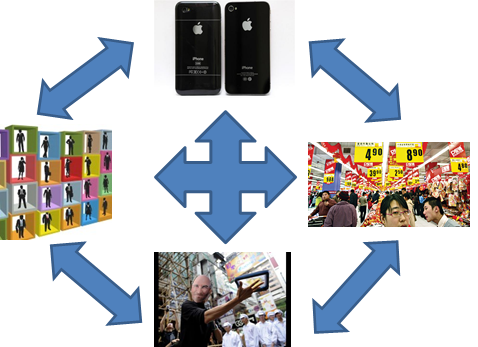
China is one of the perfect examples that apply the Porter’s diamond:


Factors conditions – China is the most populated country with 6.9 billion people. This is the same source of resource that it has that they can leverage. They have the enough skilled people, they have the available location to construct factories and they have capital from the government to be successful.
Demand conditions – Since the emerge of factories in China that manufacture different gadgets, the demand on all sorts of gadgets that you wouldn’t think of exist, are available here.
Related and supporting industries – all companies Foxconn, for example, like Hewlett-Packard, Apple, Nokia, are successful. This makes Foxconn also successful
Firm strategy, structure, rivalry – apart from being the worldwide manufacturer, China is also known for making knock-offs. This brings the rivalry among factories in China.

Factor conditions
These relate to those factors used as INPUTS in the production of goods and services.
(Code: PRICK)
P – Physical Resources like land, minerals, climate, location relative to other nations. Singapore is located in the center of Asia and the climate is moderate from not too hot and not too rainy.
R – Human Resources like skills, price, motivation, industrial relations. The skills of the people in Singapore are professionally equipped and the market for jobs are competitive.
I – Infrastructure like transport, communication, housing. The transportation in Singapore is considered one of the best, from buses to trains and even to getting taxi cabs. Communication and housing are never been outdated. These are always available to its advanced capability.
C – Capital like amounts available for investments. Singapore government has so many funds to support the inventors.
K – Knowledge like scientific and technical know-how, education institutions. Singapore has one of the best educational system in the world. They believe in producing the young and smartest citizens.

Demand conditions: the home market
The home market determines how organizations perceive, interpret and respond to buyer needs.
(N C I S S A G E)
N C I – No cultural impediments to communication
S -- Segmentations of the home market shapes an organization’s priorities
S – Sophisticated and demanding buyers at home encourage high quality standards
A – Anticipation of buyer needs
G – Growth rate
E – Early saturation of the home market encourage an organization to export

c. Influencing the diamond

d. Offshoring and outsourcing
Cost reduction is the primary reason for offshoring and outsourcing.
Offshoring is the relocation of some part of an organization’s activities to another country. The most common motivation for offshoring is to make cost savings by taking advantage of lower labor or other costs.
Example of this is the Center of Excellence that companies established to low-cost locations. This means that the scopes of job (i.e., accounting, IT support) are centralized to one area.
Challenges of Offshoring: (Code: DELETE)
D – Cultural Differences
E – Exchange rates
L – Language barrier
E – Exercising control from a distance
T – Time zones Differences
E – Example is India, as one popular offshoring country.

Outsourcing involves organization sub-contracting business activities to external providers.
Example of this is from the previous discussion on Foxconn as Global Manufacturer.
Outsourcing is appropriate for peripheral, non-core activities. If the strategic or core competencies are outsourced, this might lead to loss of competitive advantage.

Cox’s Types of competence:
Advantages of Outsourcing 
P – Long-term contract encourage PLANNING for the future
C – Remove uncertainty about COST
F – Flexibility.
E – Increase in EFFECTIVENESS where the supplier deploys higher levels of expertise
E – Access to specialist knowledge and innovations in technology is made EASIER
S – Save on cost by making use of a supplier’s economies of scale


Disadvantages of Outsourcing: (Code: SLAC)
S – Service Level Agreement
L – Loss of control over quality
A – Area of threshold competence that may be difficult to reacquire
C – Competitors might have the same outsourcing services
Newly industrializing and emerging nations (NIEs ) – countries grouped together by virtue of the fact that their economies have grown significantly in recent years and they are becoming increasingly important in the world economy.
• BRIC – Brazil, Russian, India and China – when combined, they have bigger share of the world trade than the USA
• Second tier emerging nations (Emerging Nations) – Vietnam, Indonesia, Columbia and Ukraine. South Korea, Taiwan and Mexico

e. Transition economies
This applies to countries that abandoned the Soviet-type political and economic system at the end of the 20th century. Countries included that most of which have completed their transition to a market economy and become members of EU are Russian Federation, Poland, Hungary, Romania, the Czech Republic, Ukraine, Kazakhstan, the Slovak Republic, Bulgaria and Belarus.

f. Industrialization strategies
Three main strategies:
- Export of natural commodities
- Import-substitution
- Export-led industrialization
- FDI – Foreign Direct Investment, growth of the Russian economy has been stimulated by multinational companies such as Coca-Cola establishing bases in the country

5) Different types of organization
a. The public and private sectors


b. Private sector organizations
Private Sector Organizations – also called businesses, are owned and operated by private individuals or institutions.
1) Not-for-profit organizations – they seek to avoid generating a surplus of funds, but the generation of wealth for their owners is NOT THE PRIMARY PURPOSE of their existence. Primary objective is to provide a service.
Examples are:
• Co-operatives
• Charities
• Unincorporated clubs
• Societies
• Associations
2) Mutual organizations – the essence of their nature is that they are commercial operations owned by their customers, rather than having capital and associated shareholders for whom they have earn profit.

3) Profit seeking organizations -- Businesses are of two main types, distinguished by the extent to which the owners are liable for the debts of the undertaking

a. Owners have UNLIMITED LIABILITY for the debts of their businesses
b. The legal systems of most countries provide for some form of limited liability enterprise.

4) Multinational corporations (MNCs) – These organizations have the capacity to produce in more than one country, usually with a centrally located head office.

c. Public sector organizations – two main groups:
Provide public services – such as hospitals, schools, the police and armed forces
State owned industries

6) Culture and the global organization
a. Management culture
Culture embodies the common set of values: ‘the way things are done around here’.
Factors that influence the Organization Culture (Code: Oil Ash)
O – Org’s Founder
I – Industry
L – Leadership and management style
A – Area/location of office
S – Structure and system
H – History
Management Culture – part of overall organizational culture and relates to the prevailing view within management about HOW TO DO ITS JOB.

b. Managing across borders
Geert Hofstede – identified dimensions that contributed to cross-cultural differences in beliefs and values. (Code: PUMICE)
P – Power distance—unequal distribution of power
U – Uncertainty avoidance – able to tolerate ambiguity and uncertainty
M – Masculinity versus femininity – masculine ones is competitive and assertive while feminine ones are concern for others, attention to quality of life or to the environment
I – Individualism versus collectivism – do you like to work on your own or as member of a group?
C – Confucian dynamism – position influences behavior and relationships between individuals.
E – Example that applies this is McDonalds. Countries have absorbed the influences of McDonalds and have grown familiar with the nature of the brand and what it has to offer.

Trompenaars and Hamden Turner – Seven Dimensions of Culture model
N – Neutral vs emotional – emotions aren’t expressed openly
U – Universalism vs particularism – in universalistic cultures, rules are more important than personal relationships.
I – Individualism vs collectivism – Does the culture value and encourage self-orientation and decision making or group orientation and decision making?
S – Specific vs diffuse – whether people change the way they act and related to each other in specific situations or whether behavior and relationships are consistent.
A – Achievement vs ascription – is status based on achievement or on other factors such as age and years and experience?
N –
C – Context or internal vs external or low context – high context includes tradition and ritual, the environment controls behavior. Low context is controlled by individuals rather than the environements
E
S – Sequential vs Synchronic – do individuals work on one at a time or on several things at once

Ronen and Shenker – four key characteristics at national culture
G – Work goals
R – Relationships
O – Organization and managerial factors
S – Job Satistfaction

c. Management structure
Local conditions and the scale of operations will influence the organizational structure of companies operating internationally. Very large and complex companies may be organized as a HETERACHY
- Some HQs functions are diffused geographically
- Subsidiary managers have a strategic role for the corporation as a whole
- Co-ordination is achieved through corporate culture and shared value
- Alliances can be formed with other parts of the company and with other businesses, perhaps in joint ventures or consortia

d. Influences on structure and methods
Management processes and decision making typical problems:
- Poor information systems and communication
- Interpretation of information
- Meetings

e. Human resource management
Balance between local and expatriate staff must be managed. There are number of influences:
P – Promotion opportunities
E – Experience on product and company
A – Availability of technical skills such as financial management
C – Control
E – Expats demand more costs
C – Cultural factors

Expats favoured over local stuff:
1) Poor educational opportunities in the market may require the import of skilled technicians and managers
2) Business run by expats is easier to control than one run by local staff
3) Better to communicate with the corporate center
4) Expats may know more about the organization overall, which is especially important if they are fronting a sales office
Disadvantages of choosing expats:
1) They cost more
2) Culture shock – if they fail to adjust, they will poorly manage the people effectively
3) Substantial training program might be needed: basic facts and immersion training


B – Governance and regulation
1) Government intervention in business
Country’s government has a major role to play in the success or failure of it economy
a. The macroeconomic environment
b. Legal and market regulation
c. Corporate governance and social responsibility
2) Government and the macroeconomic environment
Macroeconomic environment is concerned with factors in the overall economy.
a. The balance of trade – is the difference, in financial terms between the value of imports and exports

Factors affecting the balance of trade (CAT PIE)
C – Business cycle – nations looking for export-led growth require sufficient demand in overseas markets for their products
A – Trade agreements – affect the volume of imports and exports between nations.
T – Taxes, tariffs and trade measure – making them less attractive to buy
P – Availability, price and quality of goods produced by local producers – competitively priced goods
I – Inflation – higher than its competitors, producers in that country will face higher costs which will cause the price of their products to rise
E – Exchange rates – if currency weakens against those which export to it, then the goods it imports become more expensive

b. Fiscal policy – refers to government policy on taxation and government spending. This is based on the theories of British economist, John Maynard Keynes, that government can influence macroeconomic productivity levels by increasing or decreasing tax levels and public spending
c. Monetary policy – refers to government policy on the money supply, the monetary system, interest rates, exchange rates and the availability of credit.
i. Interest rates – attempt to influence the level of expenditure in the economy and the rate of inflation. Increase on interest rates increases the price of borrowing for both companies and individuals.
ii. Exchange rates – when it falls, exports become cheaper to overseas buyers and so the nation becomes more competitive in export markets

3) Market regulation
a. Regulation and Competition policy –could involve regulating demand, supply, price, profit, quantity, entry, exit, information, technology, or any other aspect of production and consumption in the market

b. The Competition Commission – role to promote competition
c. The Restrictive Practices Court – has jurisdiction to declare that certain agreements are contrary to the public interest and to restrain parties from enforcing them
d. European Union competition policy – intended to ensure free and fair competition in the EU
e. Self-regulation - in order to try to avert the imposition of government controls
f. Cost of regulation – EUR
i. Enforcement cost – setting up and running of the regulatory agencies
ii. Regulatory capture – regulator becomes dominated and controlled by the regulated companies, such that it acts increasingly in the latter’s interests, rather than those of consumers
iii. Unintended consequences of regulation – try to limit their effectiveness
g. Deregulation – removal or weakening of any form of statutory regulation of free market activity. This allows free market forces more scope to determine the outcome.

Advantages of deregulation:
1) Improved incentives for internal/cost efficiency
2) Improved allocative efficiency
Disadvantages of deregulation:
1) Loss of economies of scale
2) Lower quality or quantity of service
3) Need to protect competition
4) Corporate governance – companies and other entities are directed and controlled
a. Stakeholders – persons or groups that have a legitimate interest in a business’s conduct and whose concerns should be addressed as a matter of principle
b. Failures of corporate governance
i. Domination by a single individual – boards dominated by a single senior executive with other board members merely acting as a rubber stamp
ii. Lack of involvement of board
iii. Lack of adequate control function
iv. Lack of supervision
v. Lack of independent scrutiny
vi. Lack of contact with shareholders
vii. Emphasis on short-term profitability
viii. Misleading accounts and information
c. Benefits of improving corporate governance
i. Risk reduction
ii. Performance
iii. External support
iv.
d. The UK Corporate Governance Code
5) Corporate social responsibility
a. Caroll and Buchholtz’s layers of corporate social responsibility (PEEL)
P – Philanthropic – desired rather than being required of business
E – Economic -
b. Corporate Citizenship
c. Corporate social responsibility in developing nations

Tuesday, 20 September 2011

Emerging Economies


This means the stages wherein countries develop from agriculture moves towards manufacturing, towards services and resulted to demand from people and makes the economy wealthy to supply.

Examples of Emerging countries are Brazil, Russian, India and China (B R I C)

These are the topics about emerging economies:
  1.  Absolute advantage and comparative advantage
  2.  Competitive advantage
  3. Influencing the diamond
  4. Offsourcing and outsourcing
  5. Newly industrializing and emerging nations
  6. Transition economies
  7. Industrialised strategies

Absolute advantage is Adam Smith’s theory which he proposed that each nation should specialize in producing those goods that it could produce most efficiently.

This is the ability of a party (an individual, or firm, or country) to produce more of a good or service than competitors, using the same amount of resources.  Adam Smith first described the principle of absolute advantage in the context of international trade, using labor as the only input.

Since absolute advantage is determined by a simple comparison of labor productivities, it is possible for a party to have no absolute advantage in anything; in that case, according to the theory of absolute advantage, no trade will occur with the other party. It can be contrasted with the concept of comparative advantage which refers to the ability to produce a particular good at a lower opportunity cost.

Comparative advantage is David Ricardo’s theory that contradicts the absolute advantage, which means that relative opportunity costs were most relevant when considering economic activities in relation to other countries.

The law of comparative advantage says that two countries (or other kinds of parties, such as individuals or firms) can both gain from trade if, in the absence of trade, they have different relative costs for producing the same goods. Even if one country is more efficient in the production of all goods (absolute advantage), it can still gain by trading with a less-efficient country, as long as they have different relative efficiencies.
Competitive advantage is Michael Porter’s theory that argues that comparative advantage is too general. This suggests that some nations’ industries are more internationally countries than others.

Michael Porter identifies the four principal factors that impact on the competitiveness of organizations – the form the Porter’s diamond.

D – Demand conditions
I – Industries’ competitive success is linked to success of related industries
S – Strategy, structure and rivalry
C – Conditions 


Factors conditions – China is the most populated country with 6.9 billion people. This is the same source of resource that it has that they can leverage. They have the enough skilled people, they have the available location to construct factories and they have capital from the government to be successful.

Demand conditions – Since the emerge of factories in China that manufacture different gadgets, the demand on all sorts of gadgets that you wouldn’t think of exist, are available here.

Related and supporting industries – all companies Foxconn, for example, like Hewlett-Packard, Apple, Nokia, are successful. This makes Foxconn also successful.

Firm strategy, structure, rivalry – apart from being the worldwide manufacturer, China is also known for making knock-offs. This brings the rivalry among factories in China.


Factor conditions
These relate to those factors used as INPUTS in the production of goods and services.
(Code: PRICK)
P – Physical Resources like land, minerals, climate, location relative to other nations. Singapore is located in the center of Asia and the climate is moderate from not too hot and not too rainy.
R – Human Resources like skills, price, motivation, industrial relations. The skills of the people in Singapore are professionally equipped and the market for jobs are competitive.
I – Infrastructure like transport, communication, housing. The transportation in Singapore is considered one of the best, from buses to trains and even to getting taxi cabs. Communication and housing are never been outdated.  These are always available to its advanced capability.
C – Capital like amounts available for investments. Singapore government has so many funds to support the inventors.
K – Knowledge like scientific and technical know-how, education institutions. Singapore has one of the best educational system in the world. They believe in producing the young and smartest citizens.

Demand conditions: the home market
The home market determines how organizations perceive, interpret and respond to buyer needs.
(Code: N C I S  S A G E)
N C I – No cultural impediments to communication
S -- Segmentations of the home market shapes an organization’s priorities
S – Sophisticated and demanding buyers at home encourage high quality standards
A – Anticipation of buyer needs
G – Growth rate
E – Early saturation of the home market encourage an organization to export


Offshoring and outsourcing

Cost reduction is the primary reason for offshoring and outsourcing.

Offshoring is the relocation of some part of an organization’s activities to another country. The most common motivation for offshoring is to make cost savings by taking advantage of lower labor or other costs.

Example of this is the Center of Excellence that companies established to low-cost locations. This means that the scopes of job (i.e., accounting, IT support) are centralized to one area.

Challenges of Offshoring: (Code: DELETE)
D – Cultural Differences
E – Exchange rates
L – Language barrier
E – Exercising control from a distance
T – Time zones Differences
E – Example is India, as one popular offshoring country.


Outsourcing involves organization sub-contracting business activities to external providers.  
Example of this is from the previous discussion on Foxconn as Global Manufacturer.
Outsourcing is appropriate for peripheral, non-core activities. If the strategic or core competencies are outsourced, this might lead to loss of competitive advantage.

Cox’s Types of competence:

Advantages of Outsourcing (Code: PC FEES)
P – Long-term contract encourage PLANNING for the future

C – Remove uncertainty about COST

F – Flexibility.

E – Increase in EFFECTIVENESS where the supplier deploys higher levels of expertise

E – Access to specialist knowledge and innovations in technology is made EASIER

S – Save on cost by making use of a supplier’s economies of scale

Disadvantages of Outsourcing: (Code: SLAC)
S – Service Level Agreement

L – Loss of control over quality

A – Area of threshold competence that may be difficult to reacquire

C – Competitors might have the same outsourcing services


Newly industrializing and emerging nations (NIEs) – countries grouped together by virtue of the fact that their economies have grown significantly in recent years and they are becoming increasingly important in the world economy.
  • BRIC – Brazil, Russian, India and China – when combined, they have bigger share of the world trade than the USA
  • Second tier emerging nations (Emerging Nations) – Vietnam, Indonesia, Columbia and Ukraine. South Korea, Taiwan and Mexico

Transition Economies
This applies to countries that abandoned the Soviet-type political and economic system at the end of the 20th century. Countries included that most of which have completed their transition to a market economy and become members of EU are Russian Federation, Poland, Hungary, Romania, the Czech Republic, Ukraine, Kazakhstan, the Slovak Republic, Bulgaria and Belarus.