Why Study CIMA?

We're giving you more reasons to choose CIMA among all others!

CIMA VS ACCA

Cannot decide if you'll take CIMA or ACCA?

Frequently Asked Questions

You might have a lot of questions - we can help you here.

How to nail CIMA exam?

We have few tips you can follow to pass the exam.

2015 New CIMA Syllabus

Check out what is new with CIMA.

Tuesday, 8 May 2012

Learning Curves

Overview

  • The resources required to produce the given amounts of a product tend to decline as output accumulates
  • Cause of decline -- > learning curve. Workers become more adept at a task the more they perform it. This is measured mathematically
  • Cumulative average time per unit/batch decreases by a fixed percentage each time the cumulative production doubles
  • Learning rate = %

When does learning curve theory apply?
  • Labor intensive - product made largely by labor effort
  • New - brand new or relativity short-lived product
  • Complex - product made in small quantities for special orders


Example 1

A firm with a learning rate of 80% takes 50 hours to make its first unit. It has now made a total of 16 units. How long will the next 16 units take?


Formula Approach


Example 2

  • Derive the formula for the 80% learning rate and apply it to confirm the cumulative average time per unit for 16 batches in the previous illustration
  • Using the same formula, calculate the cumulative average time per unit for 20 batches
  • The formula is calculated as follows:
    • b = log 0.8/log 2 = -0.322
    • y = ax -0.322
    • At 16 batches: 50 x 16 -0.322 = 20.48
    • At 20 batches: 50 x 20 -0.322 = 19.06

Uses of the learning curve
  • Price setting
  • Budget setting
  • Production scheduling
Limitations of learning curve theory
  • Not always present
  • Assumes stable conditions which allow learning to take place
  • Assumes certain degree of motivation among employees
  • Breaks between repeating production of an item must not be too long or workers will forget and learning will have to begin again
  • Maybe difficult to obtain enough accurate data to decide what learning factor is
  • Learning is eventually cease
Practice Test

36 Batch Processing (10 Marks)
  • Standard direct labor cost of one batch of 100 units of product is $50.40
  • Standard time of 4.2 hours @ $12 per hour, with average time expected per batch based on product life of 12,800 units or 128 batches
  • Expected time for the first batch was 20 hours and an 80% learning curve
  • Company already completed 32 batches with total actual direct labor cost of $3,493
  • Direct labor variances:
    • Direct labor rate = $85 adverse
    • Direct labor efficiency = $891 adverse
  • Required:
    • Actual rate of learning
    • Total direct labor cost
  • Answers:
a) Y = axb
  • Standard cost of actual labor hours worked is actual cost less the adverse direct labor rate variance
    • $3,493 - $85 = $3,408
  • Actual labor hours worked is $3,408/$12 = 284 labor hours
  • Hours per batch = 284/32 = 8.875 hours per batch
  • Learning rate = 5√(8.875/20) = 0.85 = 85% --> 32 batches represents 5 doublings of output
b) Total direct labor cost

  • Actual labor rate is $3,493/284 = $12.30 per hour
  • b = log .85/log 2 = -0.2345
  • Average time: Y = axb
    • 20 X 128 -0.2345 = 6.41 hours
  • Total cost = average time x no. of batches x actual labor rate
      • 6.41 x 128 x $12.30
      • $10,092

37 The Learning curve effect
  • Actual output is 560 units, 3500 hours at a cost of $57,750
  • Standard time of 8 hours @ $15 per hour
  • Expected time for the first 600 units was 8 hours and an 90% learning curve
  • Direct labor variances:
    • Direct labor rate = $5,250 adverse
    • Direct labor efficiency = $14,700 Favourable
  • Required:
    • Planning and Operating variances
    • Importance of learning curves in the context of Target costing
    • 90% learning index of -0.1520
  • Answers:
a) Y = axb
  • Y = 8 X 560 -0.1520 = 3.057 hours
    • Total time for 560 units (560 X 3.057 hours) = 1,712 hours


Wednesday, 2 May 2012

Cost Planning and Analysis For Competitive Advantage

Cost Planning

Continuous improvement

  • Involves a constant effort to eliminate waste, reduce response time, simplify the design of both products and processes and to improve the quality and performance of activities that in turn will result in an increase in customer satisfaction
  • Japanese manufacturers identified two approaches to continuous improvement:
    • Target Costing
      • Setting of a target cost to challenge product designers to produce products within tight cost targets
      • A cost management tool for reducing the overall cost of a product over its entire life-cycle with the help of production, engineering, research and design
      • Four basic steps of Target Costing: 
        • (1) Define the Product 
        • (2) Set the Price and Cost Targets 
        • (3) Achieve the Targets 
        • (4) Maintain Competitive Costs
      • Happens before production
      • Competitive Market Price - Desired Profit = Target Cost
      • CIMA - Target Costing Discussion Paper

    • Kaizen Costing
      • Continuous improvement in ALL aspects of a company's performance, at every level. These improvements are through small incremental amounts rather than through large innovations
      • Setting of continuously more challenging cost targets to encourage a continuous drive for increased efficiencies
      • Yashihuro Moden defines kaizen costing as "the maintenance of present cost levels for products currently being manufactured via systematic efforts to achieve the desired cost level."
      • Happens during production
      • CIMA - Kaizen Costing Discussion Paper
Value Analysis
  • Systematic interdisciplinary examination of the factors affecting the cost of a product or service, in order to devise means of achieving the specified purpose most economically at the required standard of quality and reliability
  • AIM: Improve profitability by reducing costs without necessarily increasing prices, comprising the quality or usefulness of the product
  • Focus: To meet customer needs, while reducing costs
  • Value Analysis is a planned, scientific approach to cost reduction which reviews the material composition of a product and production design so that modifications and improvements can be made which do not reduce the value of the product to the customer or to the user. (i.e. quality for purpose should not be compromised.)
Functional analysis
  • Analysis of the relationships between product functions, their perceived value to the customer and their cost provision
  • Product functions -- represent the end benefits for customers. A mobile phone may offer a variety of functions: phone calls, music player, surfing the net, sending/receiving texts, camera and so on
  • Breakdown the product into its many functions and places and price or value on each of these functions which reflects the amount the customer is willing to pay.
  • Function 1 + Function 2 + Function 3 = Selling price of the product

Value Chain - The Philosophy of Continuous Improvement
  • Principle
    • Excellence in manufacturing is necessary for success, but it will not work alone. A firm must appreciate the relationship between all the factors in the value chain -- the sequence of business factors by which value is added to the organization's products and services

  • World-class manufacturing
    • The philosophy of continuous improvement and first class performance that underpins those organizations that get the 'value chain right.'
    • 7 Keys to World-Class Manufacturing
      • 1)  Reduce lead times
      • 2)  Speed time-to-market
      • 3)  Cut operations costs
      • 4)  Exceed customer expectations
      • 5)  Manage the global enterprise
      • 6)  Streamline outsourcing processes
      • 7)  Improve business performance visibility
  • Just-in-time concept
    • A system where the objective is to produce products as required for use of by a customer, rather than for stock. It is a 'pull' system, responsive to demand.
Just-In-Time (JIT)
  • Production system which is driven by demand for finished products whereby each component on a production line is produced only when needed for the next stage of production so there is little work in progress, and finished goods produced only when required by customers so there is little finished goods inventory.
  • JIT Purchasing - a purchasing system in which material purchases are contracted so that the receipt and usage of material, to the maximum extent possible, coincide, reducing material inventories
  • Features of JIT system:
    • Workers are multi-skilled and flexible and can easily adapt to changing demands
    • Reduces stockholdings as one of the outcomes
    • Aiming of 'zero defects', since any defect will mean late delivery to customers
    • Pull principle -- producing to customer demand
  • Just-in-time production method is also called the Toyota Production System. To meet JIT objectives, the process relies on signals or Kanban (看板 Kanban?) between different points in the process, which tell production when to make the next part.

Total Quality Management (TQM)
  • Quality - best viewed from the customer's perspective - is the product 'fit for purpose'? Failure to meet the customer's requirements will put a firm out of business
  • Cost of failing to deliver quality:
    • Appraisal costs - costs of measuring conformity with requirements, e.g. quality control inspections
    • Prevention costs - cost of ensuring that defects do not occur in the first place
    • Internal failure - e.g. costs of reworking failed products
    • External failure - e.g. product replacement, lost sales due to impact on reputation
  • Features of TQM
    • Focus on continuous improvement
    • Workforce training
    • Focus on product design
    • High quality information feedback systems to facilitate improvements
    • Use of performance measures
    • Focused on meeting customer needs
    • Workforce coordination and use of initiative
    • Emphasis on prevention not detection
    • Constant change is expected and normal
  • TQM functions on the premise that the quality of products and processes is the responsibility of everyone who is involved with the creation or consumption of the products or services offered by an organization. In other words, TQM capitalizes on the involvement of management, workforce, suppliers, and even customers, in order to meet or exceed customer expectations. Considering the practices of TQM as discussed in six empirical studies, Cua, McKone, and Schroeder (2001) identified the nine common TQM practices as cross-functional product design, process management, supplier quality management, customer involvement, information and feedback, committed leadership, strategic planning, cross-functional training, and employee involvement.

Business Process Re-engineering (BPR)
  • Involves examining business processes and radically redesigning these processes to achieve cost reduction, improved quality and customer satisfaction.
  • About major changes to how business processes opearate
Gain Sharing Arrangements
  • Involves those employees or suppliers who are involved in solving a problem or making an improvement, sharing in the benefits generated
  • Key features:
    • Knowledge sharing between staff in the organization and with the external parties (e.g. suppliers) who are working towards the solution
    • Contracts with suppliers and unions of the terms for gain sharing
    • Accurate measurement of results to facilitate calculation of benefits

Cost Analysis

The Overhead Problem
  • Absorption Costing
    • Originally designed for production companies to deal with production costs. It is less suitable for service and retail organization
    • Overheads were then only a small part of the overall costs and inaccuracies in absorption were small and insignificant
    • Never intended for use in short-term decision making, and a number of modern activity-based approaches have subsequently been developed
  • Direct Product Profitability
    • Modern way of absorbing overheads in retail organizations
    • Traditionally, bought-in cost was deducted from selling price to give gross margin. This was of little use for cost control and decision making. 
    • DPP deducts 1) buy-in price 2) indirect costs - based on the way the goods are used or created
    • DPP Calculation:

    • Advantages of DPP:
      • Cost analysis resulting in a more, accurate cost unit
      • Pricing decisions, now based on more accurate cost units
      • Management of warehouse space, by understanding the costs of stan's each product
      • Rationalism of product range based on accurate profitability estimates
      • Merchandising decisions
Activity-based costing (ABC)


In traditional costing systems, product costings can be inaccurate resulting in poor pricing decisions. This is because they tend to use labour or machine hours - an outdated approach, as most overheads do not vary directly with hours
  • Traditional Costing
    • Costs are gathered together, based on where they are incurred, i.e., cost centers and the cost objects are costed based on absorption rates
  • ABS Costing
    • Costs are gathered together, based on resource cost drivers into cost pools or cost activities, and the cost objects are costed, based on activity cost drivers
Absorbing overheads using ABC
  • Identify and collect overhead costs
  • Pool costs based on activities which have consumed resources
  • Allocate overheads to products based on cost drivers (e.g. quality control overhead may be allocated on the basis of the no. of inspections
Example:
  • Machine overhaul overhead amounts to $180,000 in one year. 
  • The cost driver has been identified as the number of set-ups, and 450 were carried out in the year
  • Charge out rate for set-ups is $180,000/450 = $400 per set-up
  • A product range requiring 75 set-ups = $400 X 75 = $30,000
  • If 25000 units of the product were produced, then the overhead per unit is $30,000/2500 = $12
Usefulness of ABC
  • Production overheads are high in relation to direct costs
  • Product range is diverse
  • Products use differing amounts of the overhead resources (e.g. complex versus simple products)
  • Consumption of overhead resource is not primarily driven by volume
Activity-based Management (ABM)


A system of management which uses activity-based cost information for a variety of purposes, including cost reduction, cost modelling and customer profitability analysis. AIM: use the information to ensure that the customer needs are met using a minimum of resources.

Advantages


Duplication - Identifies where activities are duplicated, causing waste

Overhead Control - Used to monitor overhead causing activities and thereby control overhead costs

Non Value Added - Helps to identify a non-value-added expenditure

Empowers Managers - Flags up changes in activity or resource consumption - empowers managers to view fixed costs as potentially variable


Customer Profitability Analysis


  • Different customers and customer groups will make use of different activities to varying degrees, e.g. amount of time used for product advice
  • ABC permits the creating of customer profiles and the analysis of customer profitability recognizing where customers cause additional costs to the company
  • Information can be used to target profitable customers and review the business model currently offered to less profitable ones, e.g. start changing for advice above a certain basic service level
Distribution Channel Profitability


Overview

  • Channel - point of purchase which may be direct (i.e. sales team) or indirect (i.e. through retailers). A company selects is a critical driver of business profitability
  • The method of channel distribution chosen can account for a significant proportion of total cost and choosing the wrong channel can result in significant losses.
  • It is just important for companies to cost channels as it is to cost products and customers.
  • Activity-based costing information makes it possible to cost these channels by creating cost pools for activities and understanding the affect of different channels on the cost drivers, e.g. selling to retailers will result in fewer deliveries than selling directly to customers.
Strategic Activity Management


This recognizes that individual activities are part of a wider process, which help to achieve the overall strategic aims.

ABC information can be used to assist strategic decisions, such as

  • Add-Value or Non-Value Added
  • Mass production to smaller lots
  • Changes in activities and components affect the suppliers and the value chain.


Using ABS in service industries and activities

ABC can be used by all types of organization, such as retail, service and government departments, and in all areas of the business. The key difference from manufacturing organizations are the types of cost pools, and the cost drivers used.


Problems with implementing ABC/ABM

Bureaucratic - many cost pools and significant recording of costs. In turn this is time consuming and costly

Lack of enthusiasm -- Finance staff might not understand ABC or understand the business well enough to make ABC work effectively

Complex IT - which be be expensive and time consuming to implement


Pareto Analysis


Overview

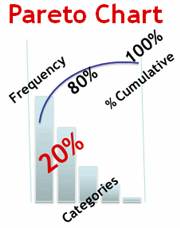
  • Based on the observed phenomenon that 80% of population's wealth is owned by 20% of the people
  • Approximation of the principle holds true in many business situations, e.g. relationship between
    • Contribution and revenue
    • Customers and profit
    • Stock items and stock value


Tuesday, 8 November 2011

Exam Rules and Regulations

Please read these carefully
1. Admission to the Exam Room


a) You must bring the following to gain entry to the exam room:


  • Your admission advice which you need to download from the CIMA website. Students sitting exams in Sri Lanka must also download their attestation form from the CIMA website and have it signed. This will not be posted to you.
  • Identification showing your photograph, with your name printed and your signature.
  • You should also bring a blue or black pen, a pencil and a calculator


b) You should be at your desk ten minutes before the start of the reading time for each exam. It is your responsibility to:

  • Make sure you sit at the correct desk by checking that your desk number matches the desk number on your admission advice for that paper. Please note that your desk number may change with each paper you sit.
  • Fill in the attendance slip before the start of each exam. This is a two-part slip – the bottom half is your receipt as confirmation that you attended the exam. Retain the completed receipt for four months from the date of the exam.

c) The doors to the exam room close 35 minutes after the start of the exam. You will not be allowed to enter the exam room after this time unless you have the permission of an invigilator.

2. Completing the front cover of your answer book

a) You will be issued with an answer book at the start of the exam.
b) You must write your candidate number on the front of your answer book. Your candidate number is on your admission advice. The invigilators will tell you when and where to complete these details on your answer book.

3. Completing your answer book
a) Write your answers in blue or black pen. You may use a pencil to draw diagrams or graphs.
b) Begin the answer to each question on a new page and write the question number in the boxes provided at the top of the page. You must clearly show the marker where a question is continued later in the book.
c) Any rough workings must be included in your answer book and then crossed through with a single line.
d) Supplementary answer books will only be handed out when you have completed your initial answer book. You must state that you are also using a supplementary answer book on the front cover of your answer book and ensure they are fastened together before collection at the end of the exam. November 2011 2


4. Permitted exam materials
a) Any personal belongings such as briefcases, mobile phones, books, dictionaries, revision notes or written material of any kind must be left in an area designated by the invigilators. They should not, under any circumstances, be left near your desk.
b) You must switch off all mobile phones prior to entering the exam room.
c) You may bring a bottle of water into the exam room.
d) Calculators must be clearly visible on your desk so that invigilators can inspect them.

We allow the following types of calculator:
- scientific calculators, including those with basic programming functions
- those with standard memory functions
- solar powered (at your own risk).

We do not allow the following types of calculator:
- those with alpha-numeric keyboards (an alphanumeric display of stored data – including text- equations or
alphanumeric formulae)
- personal organisers
- checklists and memo pads
- those that make a noise
- those that are programmable from other sources by detachable modules, barcodes, tapes or cards
- those that feature graphical displays (can often be identified by model types that end in the letter ‘G’ and
typically have larger screens)
- those that do not have their own internal power supply
- those that allow text to be saved in their memory
- calculator functions on watches or mobile phones
- those with symbolic algebraic capability.


  • You cannot use your calculator instruction booklet during the exam. It is your responsibility to check the functionality of your calculator before you use it in the exams. 
  • Please remember that, in your answer book, you must show the steps you took to arrive at your answer.
  • For more information on calculators please visit our website at:
  • www.cimaglobal.com/Documents/ImportedDocuments/guidance_on_calculators.pdf


5. Reading time


  • 20 minutes reading time is added to the three hours exam time for all exam papers.
  • During the 20 minutes you can:
    • make notes on or highlight your question paper.
    • You are not allowed to:
    • write in your answer book
    • use your calculator.

6. Conduct during Exams
a) If you need to leave the room to go to the toilet you must be accompanied by an invigilator.
b) Eating, unless for medical reasons, is not permitted in the exam room.
c) Smoking is not permitted.
d) If you contravene exam rules by, for example cheating, helping another candidate to cheat or by having materials or items with you that could give you an unfair advantage, you will be reported to CIMA’s Examinations and Assessment Oversight Panel. This is likely to result in your exam paper being voided. It may also result in CIMA taking disciplinary action against you. The following are deemed to be examples of contravention of exam rules:

  • Having any book, notes or documents on you at any time during the exam November 2011 3 Having any book, notes or documents in a situation which suggests you could have used them during the exam
  • Talking to, copying from, or in any way communicating with, another candidate
  • Using a mobile phone, including the calculator function
  • Leaving the exam room without the permission of an invigilator
  • Removing answer books and/or question papers, whether used or blank, from the exam room, during or after the exam.This list is not exhaustive.
e) Disruptive conduct during exams will not be permitted. The invigilator has the right to terminate the exam of any candidate whose behaviour is disruptive and to have the candidate escorted from the exam room. In such cases a full report will be made to CIMA’s Examinations and Assessment Oversight Panel.
f) Your answers must be written in the answer book. This includes answers to the objective questions. Any answers written on your question paper will not be marked.
g) Do not write any personal communications to the examiner or marker in your answer book. Any such
communication, particularly where it contains vulgar or threatening language will be reported to the
Examinations and Assessment Oversight Panel.

7. At the end of the exam
a) You must stop writing as soon as you are told to do so. If you do not stop writing when told, the invigilator will report your actions to CIMA.
b) You must ensure that you fasten all supplementary answer books and pieces of graph paper inside your answer book before the invigilator collects it.
c) At the end of the exam you must stay in your seat until all answer books, question papers and any other materials provided have been collected by the invigilators.
d) If you wish to leave the exam before the normal finish time you must notify the invigilator who will collect your answer books, question papers and any other provided materials before permitting you to leave the exam hall. You cannot leave the exam room during the first hour and 20 minutes or the final 15 minutes of the exam.

8. Liability
CIMA will not be liable for any loss of, theft of or damage to personal belongings left in or outside the exam room. Any personal items brought to the exam are done so at the owner’s risk CIMA Contact Centre.

If you need more information, please contact our staff at the CIMA Contact Centre.
Email: cima.contact@cimaglobal.com
Phone: +44 (0)20 8849 2251
Fax: +44 (0)20 8849 2450
CIMA Contact
26 Chapter Street
London SW1P 4NP
United Kingdom
www.cimaglobal,com

If you are based outside the UK you might find it easier to contact your local office

Tuesday, 1 November 2011

Managing Human Capital

A – Human Resource Management


1) Human resource management


a. What is human resource management?
Human Resource Management (HRM) – process of
- evaluating an organizations human resource needs,
- finding people to fill those needs, and
- getting the best work from each employee by providing the right incentives and job environment

b. The objectives of HRM (DOCS)
D – Develop an effective human component for the organization which will respond effectively to change

O – Obtain and develop the human resources required by the organization and the use and motivate them effectively

C – Create and maintain a co-operative climate of relationships within the organization and to this end to perform a ‘firefighting’ role dealing with disputes as they arise

S – Social and legal responsibilities will be met relating to the human resource

c. Why is HRM important?
Benefits of HRM (PEER)
P – Increased productivity
E – Enhanced group learning
E – Encouragement of initiative
R – Reduced staff turnover

d. Human resource management
HRM is based on the assumption that the management and deployment of staff is a key strategic factor in an organization’s competitive performance.

i. Armstrong – HRM as ‘strategic approach to the acquisition, motivation, development and management of the organization’s human resources.’

ii. Bratton and Gold – HRM as
- emphasizes that employees are crucial to achieving sustainable competitive advantage
- that HR practices need to be integrated with the corporate strategy
- and that HR specialists help organization controllers to meet both efficiency and equity objectives


iii. Tyson and Fell – suggest four major roles for HRM which illustrate the shift in emphasis to the strategic viewpoint (COBS)
C – Change
O – Organization’s central value system
B – Boundaries of the organization are maintained
S – Stability and continuity are provided

e. The human resource cycle (SPART)
S – Selection, people with the qualities and skills required
P – Performance, truly dependent on the other 4 components
A – Appraisal, targets set that contribute to the achievement of the overall strategic objectives of the organization
R – Reward, motivate and ensure valued staffs are retained
T – Training and Development, skills remain up-to-date, relevant, and comparable with the best in the industry

f. The Guest model of HRM – aim to result in high staff commitment and high quality flexible employees. Achieving these three HRM outcomes will facilitate the achievement of the behavioral, performance and financial outcomes.

g. Limitations of HRM models

External factors – competition, technology, political/legal, economic factors and social/cultural factors will all impact upon HRM
Internal factors – organizational structure and culture will also impact upon HRM

2) Human resource management theories


a. Ability – skill, knowledge and capability required of employees in order to fulfill the objectives of the organization
Taylor: Scientific management
According to Frederick W Taylor, management should be based on ‘well-recognized, clearly defined and fixed principles, instead of depending on more or less hazy ideas’

Principles of Scientific management (BIDS)
B – Bringing together of the science and the scientifically selected and trained men
I – Intimate co-operation between management and workers
D – Development of a true science of work
S – Scientific selection and progressive development of workers

b. Opportunities – employees work within an environment that is provided by their employer
Weber: Bureaucracy, rational form
Max Weber developed a theory of bureaucracy which divides the organization into jurisdictional areas (production, marketing, sales and so on) each with specified duties.

Lawrence and Lorcsch: Contingency theory
Contingency theory is based upon the idea that the organization’s structure and management approach be tailored to the situation

c. Motivation – an employee’s desire to perform their role. It is often linked to the outcome and any reward
i. Taylor, maximizing prosperity – using science to determine fair pay and selection. He believes that highest remuneration motivates the workers


ii. Mayo, Schein: Human relations – people are motivated by social or belonging needs


iii. Maslow’s hierarchy of needs – there are 7 innate needs that motivate people


iv. Herzberg’s two-factor content theory – motivators and hygiene factors


v. Adams: Equity theory – deals with issues of fairness


vi. McGregor’s Theory X and Theory Y


Theory X – most people dislike work and responsibility and will avoid both if possible
Theory Y – individuals wants to satisfy their individual needs through work and wish to make a contribution towards goals that they have helped to establish

vii. Vroom: Expectancy theory – human beings are rational and are aware of their goals and behavior.

There are two factors that strengthen the motivation;
1) preference for a certain outcome or valence and
2) outcome will result from certain behavior.

viii. Schein, common behavioral traits – there are four groups of man;
1) rational economic man,
2) social man,
3) self-actualizing man, and
4) complex man

ix. Goal-setting theory – goals can motivate


x. Mullin’s classifications of motivation – three classifications
1) economic reward,
2) intrinsic satisfaction and
3) social relationship

d. Psychological contracts – between individuals and organizations

  • Coercive contract – individual considers that they are being forced to contribute their efforts and energies involuntarily
  • Calculative contract – accepted voluntarily by the individual
  • Co-operative contract – individual identifies themselves with the organization and its goals to that they actively seek to contribute further to the achievement of those goals

3) Employee motivation: Remuneration
Pay is part of the reward system, and can be a motivator in certain circumstances.
a. Payment systems – two elements; pay and benefits
b. Pay structures
- Graded – levels of job grades
- Broad-banded structures – whole workforce
- Individual – used for senior management
- Job family structures – in terms of skill levels or responsibility
- Pay or profession/maturity curves – pay must be progressive to allocate pay fairly
- Spot rates – market price
- Rate of age – bracket for employees based on age
- Pay spines – relative across a range of roles
- Manual work pay structures – recognize the difference in status between those who work in manual roles against those in other parts of the organization
- Integrated structures – one grading system


c. Pay differentials – key to determining salaries for employees


d. Incentive schemes – to improve performance by linking it to reward
i. Performance related pay (PRP) – the most common individual PRP scheme for wage earners is straight PEICEWORK: payment of a fixed amount per unit produced, or operation completed
ii. Bonus schemes – supplementary to basic salary, and have been found to be popular with entrepreneurial types, usually in marketing and sales
- Group incentive schemes – offer a bonus for a group
- Value added schemes – improvements in productivity increases value added, and the benefit can be shared between employers and employees on an agreed formula
iii. Profit-sharing – offer employees bonuses, perhaps in the form of shares in the company, related directly to profits. This is based on the belief that all employees can contribute to profitability and that contribution should be recognized.
iv. Difficulties associated with incentive schemes
- Increased earnings simply may not be an incentive
- Workers are unlikely to be in complete control of results
- Greater specialization in production processes means that particular employees cannot be specifically credited with the success of particular products
- Instrumental orientation may encourage self-interest performance at the expense of teamwork
- It is easy to manipulate the rules of incentive scheme
- Poorly designed schemes can produce labor cost increases out of proportion to output improvements
v. Total reward schemes – is a bundle of cash and non-cash motivators offered to staff

4) Employee motivation: Other factors

a. Job redesign, rotation, enlargement and enrichment – can be used to improve the motivation of employees by introducing changes in their work

i. Job redesign – to improve performance through increasing the understanding and motivation of employees

ii. Job rotation – allows for a little variety by moving a person from one task to another

iii. Job enlargement – increases width of the job by adding extra, usually related tasks

iv. Job enrichment – increases the depth of responsibility by adding elements of planning and control to the job, therefore increasing its meaning and challenge

b. Job characteristics model – (Hackman and Oldman) sets out the links between employee motivation, satisfaction and performance and the characteristics of their job or role

MPS or Motivating Potential Score – attempt to measure a job’s potential to produce motivation and satisfaction.

Five core characteristics SITAF

S – Skill Variety: the breath of job activities and skills required
I – Task Identity: whether the job is a whole piece of work with a visible outcome
T – Task significance: the impact of the job on other people
A – Autonomy: the degree of freedom allowed in planning and executing the work
F – Feedback: the amount of information provided about the worker’s job performance

5) HR management in different types of organization


a. Project-based teams – away from traditional hierarchies towards flatter structures with reporting lines that cross functional boundaries. They operate using multi-skilled employees organized into various work team based around factors such as customer groups or particular projects

b. The new organization
i. Flat structure – more responsive because there is more direct relationship between the organization’s strategic center and the operational units serving the customer
ii. Horizontal structure – functional versatility is key to flexibility
iii. Chunked or unglued structure – teamworking and decentralization or empowerment, creating smaller and more flexible units within the overall structure
iv. Output-focused structure – focus on results, and on the customer, instead of internal processes and functions for their own sake
v. Jobless structure – the employee becomes not a job-holder but the vendor of a portfolio of demonstrated outputs and competences

c. Virtual organization (TACO)

T – Territorially organized without the overhead cost of local offices, without the difficulties of supervision, communication and control
A – Adopt flexible cross-functional and multi-skilled working, by making expertise available across the organization.

C – Centralize shared functions and service without the disadvantages of geographical centralization and with the advantages of decentralized authority
O – Outsource areas of organizational activity without losing control or co-ordination


6) Working arrangements


a. Attitudes and values
i. Multi-skilling – involves individuals who are able to perform a variety of team tasks, as required
ii. Flexibility – about being able to respond and adapt quickly to rapidly changing customer demands
iii. Empowerment – involves giving employees the freedom to take responsibility for their goals and actions

b. Flexible working arrangements – balance between professional and personal responsibilities
i. Flexitime – arrangement where employees work the standard number of hours in a workday, but are given some flexibility as to when they work these hours
ii. Compressed week – employee works the standard number of hours in one-or two week period, but compresses those hours into fewer work days
iii. Job sharing – two employees share one position
iv. Part-time/reduced hours – employee works less than the standard work week hours
v. Telecommuting or homeworking – employee works either part or all the week from a location other than the standard place of work

c. Flexibility in organizations

i. Numerical – use of temporary workers – both contractors and agency staff
ii. Financial – achieved through variable systems of reward
iii. Task – involves having employees able to undertake a wider range of tasks.

7) The HR plan
a. HR planning – concerns the acquisition, utilization, improvement and return of an enterprise’s HR


  • Budgeting and cost control
  • Recruitment
  • Retention
  • Downsizing
  • Training and retraining to enhance the skills base
  • Dealing with changing circumstances

b. Strategic analysis

  • Environment – population and education trends, policies on the employment of women and on pension ages and trends generally in the employment market must be monitored
  • HR strengths, weaknesses, opportunities and threats need to be analyzed
  • HR utilization – how effectively the organization is currently utilizing its staff
  • Objective – core and subsidiary objectives should be analyzed to identify the manpower implications

c. Forecasting

  • Estimating demand – accurate forecasts of turnover and productivity
  • Estimating supply – current works and the external labor market
  • Position survey – compares the demand and supply
d. Closing the gap between demand and supply: The HR plan

  • Recruitment plan – numbers, types of people, when required, recruitment program
  • Training plan – numbers of trainees required and/or existing staff needing training, training program
  • Redevelopment plan – program for transferring, retraining employees
  • Productivity plan – improving productivity, reducing manpower costs, setting productivity targets
  • Redundancy plan – where and when redundancies are to occur, policies for selection and declaration of redundancies, re-development, re-training, or relocation of redundant employees, policy on redundancy payments, union consultation
  • Retention plan – actions to reduce avoidable labor wastage

e. Tactical plans

  • Pay and productivity bargaining
  • Physical conditions of employment
  • Management and technical development and career development
  • Organization and job specifications
  • Recruitment and redundancies
  • Training and retraining
  • Staffing cost

f. Staffing shortages or surpluses
i. Shortage
- Internal transfers and promotions, training
- External recruitment
- Reducing labor turnover, by reviewing possible causes
- Overtime
- New equipment and training to improve productivity so reducing the need for more people
ii. Surplus
- Allowing employee numbers to reduce through natural wastage
- Restricting recruitment
- Introduce part-time working for previously full-time employees
- Redundancies – as a last resort, and with careful planning

g. Stages in human planning


h. Control over the HR plan

  • Actual numbers recruited, leaving and promoted vs planned numbers
  • Actual pay, conditions of employment and training vs assumptions in the HR plan
  • Periodical review of HR plan

8) Ethical behavior


a. Ethics in business practice – the application of ethical values to business behavior
Three Elements (I DO BEST)
I – concern an individual’s professional responsibility to act
DO – concern the ‘real world’ practical actions an individual can take
BEST – concern choices between different courses of action

‘Trust me’ – family owned business
‘Involve me’ – run by board of directors
‘Show me’ – demonstration of trust
‘Prove to me’ – required independent verification and assurance
‘Obey me’ – when the law creates legislation to cure instances of unethical behavior

b. Social Responsibility policies and reports
i. Corporate social responsibility – approach to helping the community and reducing the environmental impact of the organization
ii. Corporate Responsibility reports – focus included figures or statistics covering areas such as the organization’s carbon footprint and impact on the environment

c. CIMA’s Ethical guidelines
i. Observe the highest standards of conduct and integrity
ii. Uphold the good standing and reputation of the profession
iii. Refrain from any conduct which might discredit the profession

Fundamental principles (BIOP-C)

B - Professional behavior – protect the reputation of the professional and the professional body, and comply with relevant laws and regulations

I - Integrity – must not be party to anything which is deceptive or misleading
O - Objectivity – fairness and avoiding all forms of bias, prejudice and partiality
P - Professional competence and due care – remain up-to-date with current developments and are technically competent
C - Confidentiality – confidential information will not be revealed without specific permission or unless there is a legal professional right or duty to do so


B – Human Resource Practices


1) Good HR practice
a. Recruitment and selection
Recruitment – concerned with finding applicants: going out into the labor market, communicating opportunities and information and generating interest

Selection – consists of procedures to choose the successful candidate from among those made available by the recruitment effort

b. The recruitment process
i. Job Analysis – process of collecting, analyzing and setting out information about the content of jobs in order to provide the basis for a job description and data for recruitment, training, job evaluation and performance management.
ii. Job Design – current approach is the development and outlining of competences
Competence – capacity that leads to behavior that meets the job demands within the parameters of the organizational environment and that, in turn, brings about desired results.

Different types of competences (POG)
P - Behavioural/personal – underlying personal characteristics and behavior required for successful performance, for example ability to relate well to others
O - Work-based/occupational – expectations of workplace performance and the outputs and standards people in specific roles are expected to obtain
G - Generic – can apply to all people in an occupation

Parameters of job design
a) Job specialization
b) Regulation of behavior
c) Training in skills

iii. Job Description and person specification
Job Description – sets out the purpose of the job, where it fits in the organization structure, the context of the job, the accountabilities of the job and the main task the holder carries out

4 Main Purposes of a Job Description
a) Organizational – job’s place in the organization
b) Recruitment – information for identifying the sort of person needed
c) Legal – basis for contract of employment
d) Performance – set around the job description

iv. Advertising job vacancies – the choice of advertising medium will depend on COST, FREQUENCY, the frequency with which the organization wants to advertise the job vacancy and its SUITABILITY to the target audience

v. Initial screening – reviewing curriculum vitaes and selecting some candidates for interview

c. Selection – involves a filtering process, by reviewing applications forms, interviewing and testing


i. Application forms – usual for jobs below executive level and all levels in the public sector

ii. The interview: Preparation – finding the best person for the job through direct assessment and giving the applicant the chance to learn about the business

iii. The Interview: Conduct – layout of the room and number of interviewers, manner of the interviews, questions should be put carefully, give candidates chance to talk and ask questions

iv. Type of job interview (TIPS)
T - Tandem
I - Individual
P - Panel
S - Sequential


v. Limitations of interviews CASEL
C – Contagious Bias
A – Assessment is incorrect
S – Stereotype
E – Halo Effect
L – Logical error

vi. Testing the candidates
- Psychological tests and personality test
- Cognitive test – thinking processes
- Proficiency test – measure ability to do work involved
- Psychometric test – All of the above

vii. Advantages and disadvantages of test
Advantages: (3S)
- Sensitive measuring instrument
- Standardized
- Same
Disadvantages
- Over-simplify complex issues
- Culturally-specific
- Results should only be used to support other selection methods

viii. Group selection methods – consist of series of tests, interviews and group situations over a period of two days or so, involving a small number of candidates for a job.

ix. Assessment centers – refers more the process of selection rather than to any specific building. It involves the candidate’s behavior being observed and judged by more than one assessor, using specifically developed situations.

x. Are assessment centers effective? – also used to identify training and development needs or to enhance skills.

xi. References – enables an employer to check the basic accuracy of the candidate’s CV.

xii. Negotiation - it is important that both employer and employee feel that the exchange they have contracted is a FAIR one.

xiii. Realistic job previews – know what they are letting themselves in for. It involves a prospective employee spending some time shadowing an existing employee in a similar role

d. Induction – orientation

Dialogic learning – integrating recruits into how the organization operates including the overall culture, beliefs and mission

e. Legal and ethical issues

2) Human resource development


a. Training and development strategy
b. Effective learning programs
c. Training and the organization
d. Training and the employee
e. Possible shortcoming of training
f. Training and development needs
g. Setting training objectives
h. Incorporating training needs into individual development program
i. Formal training
j. On the job training
k. The learning cycle (Kolb)
l. Training in different industries or sectors
m. Evaluating training
n. Career management
o. Management development
p. The transition from functional to general management

3) Appraisal
a. Why are appraisals needed?
b. The purpose of appraisal
c. An appraisal system
d. Problems of appraisal system
e. Appraisal techniques
f. Self-appraisal
g. Upward appraisal
h. Customer appraisal
i. 360 degree appraisal
j. The appraisal report
k. Interviews and counseling
l. Follow-up
m. Improving the appraisal system
n. Appraisal and reward
o. Management expertise and employee empowerment
p. Making improvements

Tuesday, 18 October 2011

Marketing

A – Marketing and Business Strategy
  • The marketing concept
  • The marketing environment
  • Marketing and corporate strategy
  • Marketing strategy
B – Marketing Plans, Branding and Communications

  • Marketing action plans
  • Branding
  • Marketing communications

C – Developments in Marketing

  • Consumer behaviour
  • Marketing not-for-profit organisations
  • Internal marketing
  • Corporate social responsibility and social marketing

A – Marketing and Business Strategy

1. The marketing concept


a. What is marketing
Marketing – process of planning and executing the concepts of pricing, promotion and distribution of ideas, goods and services in order to create exchanges that satisfy individual and organizational objectives.

Kotler – right product at the right price at the right time

b. Products, goods and services: a note on terminology
Product – something that is offered to a market

Examples:
FMCG – fast moving consumer goods like soaps and shampoo
Services – like haircut or tailor services

c. Strategic and tactical marketing
Strategic – this is the corporate strategy which identifies the products and markets the organization wishes to operate in (i.e. Fashion retailer opens a
Tactical – short-term and particular elements of marketing mix (i.e. Year-end Sale)

d. Exchanges – the role of marketing is to identify, anticipate and supply satisfaction to customers, to facilitate mutually beneficial exchanges

e. The marketing concept and marketing orientation – these are two interrelated terms.

Brassington and Pettit (2000)
Marketing concept – a philosophy of business
Marketing orientation – approach of the business

f. The marketing concept – a belief system. Can incorporate to culture. Normally refers to the customer satisfaction.

g. Marketing orientation – there are three types of other orientations that marketing orientation can relate to: production, sales and product

Production orientation – success is achieved through producing goods or services of optimum quality as cost-efficiently as possible
Sales orientation – makes the product and actively and aggressively sells it
Product orientation – focus on product development; new product features

h. The potential impact of a marketing orientation – bottom-line is that companies should focus on customer needs

i. Push VS Pull Marketing

Push marketing – traditional; pushing goods out to resellers and consumers
Pull marketing – produce a product that consumer demand will pull into retail outlets

j. Three Dimensions of Marketing (CST)
C – Culture, consumer needs
S – Strategy, select the markets it intends to sell to and the products or services it will sell
T – Tactics, 7Ps of the marketing mix


2. The marketing environment


Three levels:
Macro – all factors that can influence the organization (i.e. PESTEL factors)
Micro – factors specifically related to the organization (i.e. customer and suppliers)
Internal – factors within the organization (i.e. assets, employees and finance)

a. PESTEL Factors


PPolitical, changes in gov’t policies will affect consumers’ spending power or rights
EEconomic, economic growth, exchanges rate which affects the demand for product or services
SSocial/Cultural, demography suggests the size and the purchasing power of the customers
TTechnological, new products or processes, which the customers have different attitudes towards innovation
EEcological, climate change or catastrophes can change the customers’ attitude towards products that will aid them
LLegal, laws affect ways of doing business and it is the question to customers if they are willing and able to take legal action

b. SWOT Analysis
Internal appraisal: strengths and weaknesses – to shape the organization’s approach to external world
External appraisal: opportunities and threats --

3. Marketing and Corporate Strategy

a. Corporate and marketing strategy (BIOGESIC)

B – Between and among corporate and marketing strategy
I – Internal appraisal, corporate will review the effectiveness of different aspects of the organization, marketing will conduct marketing audit
O – Setting objectives, corporate will increase profit, marketing will increase market share
G – Gaps, corporate has gaps between objectives and forecast, marketing will focus on growth
E – External appraisal, corporate will review PESTEL factors that impacting on the whole organization, marketing will review the factors that affect customers, products and markets
S – Strategy, corporate will develop strategies to fill up the gap, marketing will focus on resources that will be allocated to them to be able to identify the target market, plan the product to produce and organize them.
I – Implementation, corporate will delegate this to each department, marketing will put this into action like ads space
C – Control, corporate is reviewing the results and starts planning again, marketing will review if the market share objectives have been achieved

b. The marketing plan – must be consistent with the corporate strategy (STAGES ABC)
S – Marketing Strategy, target markets, the marketing mix and marketing expenditure levels
T – Tactical marketing plan, one year time horizon
A – Situation analysis, SWOT analysis and forecasts
G – Goals and objectives, what organization is hoping to achieve
E – Executive summary, finalized the planning document
S – Strategic marketing plan, defines scope of product and market activities
A – Action plan, how strategies are to be achieved
B – Budgets, action programme
C – Controls, monitor the progress of the plan and the budget


4. Marketing strategy


Key activities (RMTP)
R – Research, initial stage on obtaining data about the customers and their needs
M – Market segmentation, group of customers with similar characteristics
T – Targeting, choose one or more targets after analyzing the attractiveness of the segment
P – Positioning, act of designing the company’s offer and image

a. Market research – gathering, recording, analyzing and reporting data and information relating to the company’s market, customers and competitors

Five Steps:
1) Defining the problem (i.e. why sales are decreasing, what are the potential demands in the market)
2) Developing hypotheses to be tested (i.e. the product is not effective?)
3) Analyze and interpret the data
4) Report the findings

Quantitative vs qualitative data
Quantitative – enables measurement (i.e. surveys)
Qualitative – not measurable but useful to get people to say what they feel and thing

Secondary vs primary
Secondary – generated by sources internal or external to the organization. It is not intended for specific research and cheaper than primary data (i.e. accounting data, customer databases, and published statistics from government)
Primary – intended for specific research (i.e. experiment, observation, focus groups)

b. Forecasting demand (CPF MISES)
C – Current Demand
P – Past-sales analysis, trends, seasonal factors
F – Future Demands
M – Market test
I – Survey of buyers’ intentions
S – Sales force opinions
E – Expert opinions
S – Sales potentials

c. Market segmentation – subdividing of a market into distinct and increasingly homogeneous subgroups of customers, where any subgroup can conceivably be selected as a target market to be met with a distinct marketing mix.

Bases of segmentation:
Simple – like geographical area, age, gender, level of income, occupation
Lifestyle – deals with person’s distinctive ways of living adopted by particular communities or subsections of society.

Four categories of lifestyle segmentation (SHUT)
S – Security and status seeking, safety and ego-defensive needs
H – Hedonistic preference, enjoying life now
U – Upwardly mobile, ambitious, more affluent lifestyle
T – Traditional and sociable, compliance and conformity to group

d. Target markets – market or segment selected for special attention by an organization
Mass or Undifferentiated – produce a single product and get as many customers as possible
Concentrated – produce an ideal product for a single segment of the market (Rolls Royce, Ferrari)
Differentiated – several products for different market segment

e. Positioning – market position refers to how customer perceive a brand or product relative to other brands or products

f. Developments in market segmentation and product positioning – refers to the evolution on how segmentation and positioning are considered in organizations (D’CASH)

D – Data Mining, interest on customer database analysis and the idea of ‘letting the data speak for itself’
C – Computer models are used
A – Awareness that consumers should be segmented
S – Soft data, focusing on the lifestyle rather than the hard or basic segmentation
H – Hybrid segmentation, sub-dividing a segment to different sub-segments

g. The Ansoff matrix – (1987) showing possible strategies for products and markets


Market penetration – existing products and markets
Market development – existing products for new markets
Product development – redesign or repositioning of existing products
Diversification – new products for new markets

B – Marketing Plans, Branding and Communications

1. Marketing action plans


a. The marketing mix (7P’s of marketing mix)


Four P’s of consumer goods:

  • Product
  • Price
  • Place
  • Promotion

Three P’s of services

  • People
  • Processes
  • Physical evidence

b. Product – anything that satisfies a need or want.
Organization’s point of view: what is being sold
Customers’ point of view: solution to a problem or a package of benefits

Product classifications
Consumer goods – sold directly to the person (CUSS)
C – Convenience goods (i.e. groceries)
U – Unsought goods (i.e. wardrobe organizer)
S – Shopping goods (i.e. durable items like furniture or appliances)
S – Specialty goods (i.e. jewelries)

Industrial goods – used in the production of other products (RACIS)
R – Raw materials (i.e. plastic, metal, wood)
A – Accessories (i.e. PCs)
C – Components (i.e. Intel microchip in most PCs)
I – Installations (i.e. factory assembly line)
S – Supplies (i.e. office stationery)

Product levels
Core – all products should have
Actual/basic – features offered as part of the product
Expected – attributes that the customers expect, either will disappoint or delight them
Augmented – extra benefits that differentiate it from other products
Potential – possibility to enhance or develop the product


The BCG Matrix
Question mark – a small market share in a high growth industry, which means competition, is really strong and to be successful will require substantial funds
Star – high market share in a high growth industry, which has potential of generating significant earnings, currently and in the future.
Cash Cow – high market share in a mature slow-growth market, this has high degree of consumer loyalty and will make a substantial contribution to overall profitability
Dog – low market share in a low-growth market, losing consumer support.

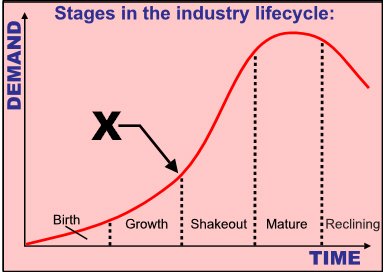
The product life cycle
Introduction stage – offering something new to customers
Growth stage – the volume of demand for the product increases
Shake out – weaker players in the market are shaken out by the stronger organizations
Market Maturity – Demands levels off
Decline stage – total demand declines and competitors will start to withdraw from the market

c. Place – how product reaches its customers
Channel – supermarkets, corner shops
Logistics – warehouses
Direct distribution – retailers

d. Promotion
Aims of promotion (AIDA)
A – Arouse Attention


I – Generate Interest


D – Inspire Desire


A – Initiate Action

e. Price
Three main types of influence on price setting:

  • Cost – most important influence on price, like cost-plus rules (cost plus profit margin)
  • Competition – average level of price becomes the norm including the standard price differentials between brands. Price competition may be avoided by informal agreement, in cases of cigarettes and petrol.
  • Demand – strong demand may lead to a high price, and a weak demand to a low price


f. Price Setting strategies

Market Penetration – sets a relatively low price for the product or service in order to stimulate growth of the market
Market Skimming – sets a high initial price for a new product in order to take advantage of those buyers who are ready to pay a much higher price for it.
Early cash recovery – aims to recover the investment in a new product or service as quickly as possible to achieve a minimum payback period.
Product line promotion – focuses on profit from the range of products which the organization produces rather than to treat each product as separate entity.
Cost-plus pricing – marking up its unit costs by a certain percentage or fixed amount
Target pricing – price that gives a specified rate of return for a given output
Price discrimination/selective pricing – different prices for the same product when it is sold in different markets
Going rate/competitive prices – keep in line with industry norm for prices
Price leadership/predatory pricing – price leader generally has a large market share. The role of the price leader is based on a track record of having initiated price moves that have been accepted by both competitors and customers.

g. Services and service marketing
Characteristics of services (as distinguished from goods) (IHI PO)
I – Intangibility, lack of substance which is involved with service delivery
H – Heterogeneity, lack of sameness or consistency. The quality of service may depend heavily on who it is that delivers the service
I – Inseparability, services cannot be separated off from the provided. Should instill values of quality, reliability and to generate a service ethic
P – Perishability, services cannot be stores. Anticipating and responding to levels of demand is key planning activity
O – Ownership, services do not result in the transfer of property.

h. The extended marketing mix (3P’s)
P – People, services are provided by members of staff who are inseparable from the service
P – Process, services involve a process, for example a haircut may involve waiting to be served, a hair wash, styling, colouring and hair dying
P – Physical evidence, as services are intangible, some physical item should be provided to give the customer evidence of ownership

2. Branding


Brand – is a name, term, sign, symbol or design intended to identify the product of a seller and to differentiate it from those of competitors.

Brand name – refers strictly to letters, words, or groups of words which can be spoken

Brand Image – distinguishes a company’s product from competing products in the eyes of the user

a. Objective of branding
Key benefit of branding is product differentiation and recognition. Products may be branded for a number of reasons (DARED ME)
D – Product differentiation helps customers to identify the goods or service and creates customer loyalty to the brand
A – Advertising, maximizes the advertising for product identification and recognition
R – Readier acceptance, by wholesalers and retailers
E – Brand extension, or stretching which other products can be introduced into the brand range to ‘piggy back’ on the articles already known to the customer
D – Price differentials, reduces the differences on prices between goods
M – Market segmentation, different brands of similar products may be developed to meet specific needs of categories of uses
E – Eases the task of personal selling, by enhancing product recognition.

b. Branding Strategies
Three broad branding strategies

  • Brand extension – introduction of new flavors, sizes etc to a brand, to capitalize on existing brand loyalty
  • Multi-branding – introduction of a number of brands that all satisfy very similar product characteristics and normally used where there is no brand loyalty
  • Family branding – uses the power of the brand name to assist all products in a range


c. Brand value
Three approach on valuing brand: (MIC)

  • M – Market approach
    • Based on market transactions
    • Relief-from –royalty
  • I – Income approach
    • Based on net present values
    • Calculating the overall economic benefit that will generate over its life
  • C – Cost approach
    •  Based on the costs incurred to build the brand
    • Example are costs involved in registering trademarks and promotional activities
3. Marketing communications


a. The promotion mix – consists of the blend of promotional tools that are considered appropriate for a specific marketing campaign

b. Consumer and business to business markets
Consumer markets (business-to-consumer markets B2C) – consists of mass audiences which are cost-effectively accessible by television or national newspaper advertising
Business-to-business markets (B2B) – involve a great deal of personal selling at different levels in the organization.

c. Integrated marketing communications – represent all the elements of an organization’s marketing mix that favorably influence its customers or clients.

d. Types of marketing

i. Consumer marketing (4Ps)
ii. Service marketing (3Ps)
iii. Direct marketing
iv. Indirect
v. Guerrilla
vi. Viral
vii. Interactive
viii. Experiential
ix. E-marketing
x. Internal marketing

e. Direct marketing – the planned recording, analysis and tracking of customer behavior to develop relational marketing strategies. (RIRAS)
R – Response, getting people to respond to invitations and offers
I – Interactive, two way involving supplier and customer
R – Relationship, on-going process of communicating and selling again and again to the same customer
A – Recording and Analysis, for most cost-effective procedures
S – Strategy, part of a comprehensive plan stemming from clearly formulated objectives

Example of direct marketing is TELEMARKETING. Telemarketing is a quick, accurate and flexible tool for gathering, maintaining and helping to exploit relevant up-to-date information about customers and prospects

Characteristics of telemarketing (IT FITS)
I – Interactive
T – Targeted
F – Flexible
I – Immediate
T – Telemarketers are attending personally
S – So costly

f. Indirect marketing – marketing of products as a consequence of another activity or action. Organization doesn’t push products or services onto customers. (i.e. posting blogs on internet, ‘word of mouth’)

g. Guerilla marketing – involves taking people by surprise and creating a buzz in unexpected places. It relies more use of imagination that large sums of money.

Principles of guerilla marketing:
- Small organization
- Based on psychology rather than experience
- Based on time, energy and imagination
- Judged on profit not sales
- New relationships created
- Standard of excellence
- Number of customer referrals
- Co-operate with competitors
- Combination of marketing methods should be used
- Use of technology

h. Viral marketing – involves the use of pre-existing social networks to spread brand awareness or other marketing objectives.

i. Interactive marketing –ability to address the customer, remember what the customer says and address the customer again in a way that illustrates that we remember what the customer has told us. Example is Amazon.com

j. Experiential marketing – involves providing an experience that creates an emotional connection between a person and a brand or idea. This is an effective way of connecting with customers, as the emotional connection encourages brand loyalty

k. E-marketing – includes website, SMS e-mail, online surveys and use of social networks like Facebook and Twitter.


C – Developments in Marketing

1. Consumer behaviour

a. The customer
Different roles of customer (PUB)
P – Payer, the person who finances the purchase
U – User, receives the benefit of the product
B – Buyer, who selects a product

b. Buyer behavior – describes the activities and decision processes relating to buying
i. Consumers as buyer
ii. Organization as buyer

c. Consumer buying behavior (HCL)
H – Habitual decision making, emphasizes habit and brand loyalty
C – Cognitive paradigm, purchase as outcome of a rational decision-making process
L – Learned behavior, importance of past purchases

5 stages of consumer buying process:
1) Need/problem recognition – the customer recognizes a need or a problem to solve. There is a motive to search for a solution
2) Pre-purchase/information search – the customer searches for information they can use to base their decision on
3) Evaluation of alternatives – the customer evaluates the various options they have generated
4) The purchase decision – is made and the product or service selected based on how it meets their needs and other factors such as cost
5) Post-purchase evaluation – if dissatisfied, they will be back at the problem recognition stage. If they are satisfied, the next decision process for the product may be cut short and they may skip straight to the decision, on the basis of loyalty

d. Influences on consumer buying
Social relate to social groupings a consumer belongs to or aspires, and trends in society which influence buying patterns
Cultural – comprises the values, attitudes and beliefs in the pattern of life adopted by people that help them integrate and communicate as member of the society
Personal – include such things as age, stage of family and life cycle, occupation, economic circumstances and lifestyle
Psychological – includes the four factors;
1) Motivation – inner state that energizes, activates or moves that directs or channels
2) Perception – people select, organize and interpret sensory stimuli into a meaningful and coherent picture
3) Learning – individual’s behavior changes as a result of their experience
4) Beliefs and attitudes – descriptive thought that a person holds about something. Attitude describes a person’s enduring favorable or unfavorable cognitive evaluations, emotional feelings, and action tendencies toward some object or idea

e. Organizations as buyers


Organizations are viewed as more RATIONAL than individuals

Business-to-Business or B2B - transactions between organizations
Business-to-Consumer or B2C - transactions involving an organization and a consumer

Organizational markets (PICO)
P- Purchase decision is usually made by consensus in an organizational setting, rather than being the responsibility of one person
I - Inelastic demand for industrial goods, which means these are not affected by price changes
C - Close relationship between buyer and seller
O - Organizational markets normally comprise fewer buyers responsible for the majority of sales


Decision Making Unit (DMU)

Webster and Wind (1972) suggested six groups within DMU (GUIDES)
G - Gatekeepers. By controlling the flow of information, may be able to stop sellers from reaching individuals within the buying center
U - Users. Initiate the buying process and help define purchase specifications
I - Influencers. Help define the specification and also provide an input into the process of evaluating the available alternatives
D - Deciders. Have the responsibility for deciding on product requirements and suppliers
E - Example of approvers are Finance Director/Manager
S - Suppliers or Buyers. Have the formal authority for the selection of suppliers and negotiating purchase terms


2. Marketing not-for-profit organizations

a. Charity and not-for-profit marketing
b. Characteristics of charity and not-for-profit marketing
c. The charity marketing mix

3. Internal marketing
a. Implementing internal marketing
b. The internal marketing mix
c. Segmenting the internal market
d. The importance of internal customer communications
e. Challenges for internal communication
f. Tools of internal communication

4. Corporate social responsibility and social marketing
a. Social responsibility, ethics and the law
b. Ethical marketing
c. Social marketing